
Policy & code reform
Changing the rules that changed the neighborhood.
Missing middle housing is rarely blocked by a construction problem. It is blocked by rules: zoning that forbids the building type, codes written for larger projects, and financing boxes that small deals do not fit. We work on both sides, building the projects and reforming the rules. Malone Park Commons was our learning lab, and the lessons became Memphis and Shelby County's Appendix M and Tennessee's House Bill 2787.
Firsts under the code
Every one of these took bringing an inspector along.
Code reform at ground level looks like this: a building method that is proven elsewhere, a local code that has never seen it, and a builder willing to do the work of getting it approved. Jones Urban was the first in Shelby County to do each of the following.
- Sealed crawlspace foundations. First building firm approved by Shelby County Code Enforcement to use a sealed, conditioned crawlspace, a healthier and more efficient alternative to a vented one.
- All-electric EcoBuild homes. First to build an all-electric home meeting MLGW's EcoBuild energy-efficiency requirements.
- Ductless heat pumps for the whole house. First in Shelby County to heat and cool an entire home with ductless mini-split heat pumps.
- Electric tankless water heating. First in Shelby County to use electric tankless water heaters for whole-house hot water.
Raised floor foundations are our standard practice. Each of these is now a normal thing to do in Memphis. None of them was when we started.
The ADU story
Legal in 2011. Proven on the ground since.
The Memphis and Shelby County Unified Development Code, enacted in June 2011, legalized accessory dwelling units on single-family lots for the first time in a generation. A rule change on paper does not put a backyard cottage on a lot. Somebody has to design one that fits, get it through permitting, build it at a cost that works, and show the neighbors it is a good thing.
Jones Urban was an early builder under that provision. The cottages we built then are the reason we could build a whole block of them later, and the reason we can tell a planning commission exactly what an ADU rule does to a small project's budget and timeline.
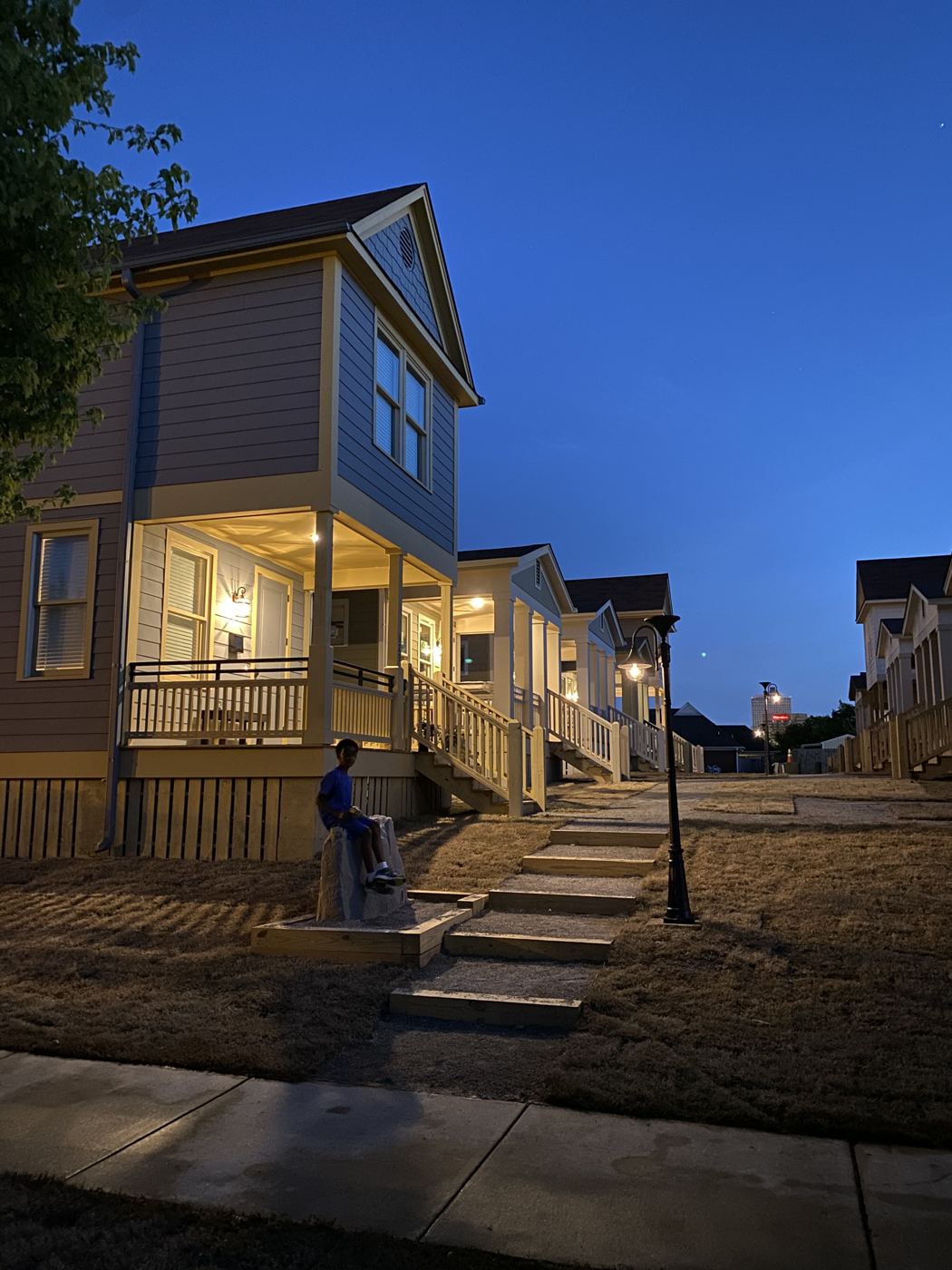
The learning lab
Malone Park Commons showed us exactly where the code breaks.
We built one Memphis block with cottages, fourplexes, and live-work buildings, and every time a design crossed from two homes to three, it triggered rules written for large apartment buildings. We used that block as a learning lab, documented each barrier, and took the fixes to the city and the state.
Appendix M: the Large Home Amendment
In November 2021 Memphis and Shelby County amended their residential building code so that buildings of three to six homes are reviewed under the residential code, the same code a large house follows, instead of the commercial code. Fire safety scales with building size: rated separations between homes, with a residential sprinkler system for smaller buildings and a full system only for larger ones. Separate engineered drawings for every trade are no longer required for a fourplex. We advocated for this amendment from a seat on the Memphis and Shelby County Building Code Advisory Board, with Malone Park Commons as the working example.
House Bill 2787: Tennessee follows
When the State Fire Marshal pushed back on the local amendment, we helped carry the issue to Nashville. Tennessee House Bill 2787, enacted in 2024 as Public Chapter 771, lets any local government in the state place three- and four-family dwellings under its residential code. For buildings under 5,000 square feet and under three stories with two-hour fire separations, the state may not mandate a sprinkler system, and a lower-cost residential sprinkler standard may be allowed by local ordinance. What we proved on one block in Uptown is now an option for every city in Tennessee.
The reforms did not stop at the building code. After the state law passed, Memphis Light, Gas and Water revised its policy so buildings of up to four homes qualify for residential utility service instead of commercial taps and meters, saving thousands of dollars per home. Zoning relief, design review, brownfield cleanup, and incentive applications all got the same treatment on our projects: go through the process, write down where it costs a small building months or dollars it should not, and bring that record to the people who can change it.
The conversations we want to be part of
Where the rules still get in the way.
Missing middle by right
Duplexes through fourplexes and cottage courts allowed on ordinary residential lots without a rezoning or a variance.
Lot size and setbacks
Minimum lot sizes and setback rules that make a small lot unbuildable, and a small building on a normal lot illegal.
Parking minimums
Parking requirements that consume the yard a cottage court needs and add cost that a small project cannot carry.
Building code thresholds
The line between residential and commercial code that turns a three- or four-home building into a much more expensive one.
Utility and site rules
Connection, metering, and infrastructure standards sized for subdivisions, applied to one building on one lot.
Financing that fits
Lending and incentive programs that recognize a five-home building as a small deal, not a failed large one.
Bring us into the room.
Cities, planning departments, and advocacy organizations: we bring lived experience with what the code actually does to a small project. We are glad to share it.